Retreat
Yoga Nidra as a gentle way to raise consciousness and to meet death, dying and fear with peace.
Starting dates
Starting dates on request, please enquire for the next dates. The retreat includes six nights’ accommodation.
Introduction
Caring for a dying family member or friend is one of the hardest things we do. Before we can give to others, we first have to be at peace with our own mortality and fears. From that inner steadiness, support and compassion for others can flow with ease.
Yoga Nidra offers a gentle way to raise consciousness, and gives tools that help release tension, pain and fear in difficult situations.
In this light, yoga can be translated as the union of life and death, and Yoga Nidra as the science of raising and changing states of consciousness.
The Yoga Nidra classes focus on particular aversions and obstacles, and on practices of connection and support.
Special emphasis is given to the dream and sleep states. They can be seen as small daily deaths: nightly chances to train, to prepare, and to know a different consciousness by day and by night. In the Tibetan Bön tradition, these states are regarded as training for the process of dying.
From the same tradition comes a way of being with pain: connect first with stillness, silence and spaciousness, then care for the pain and the difficult situation from that steadier ground. Obstacles loosen their grip, and have space to dissolve.
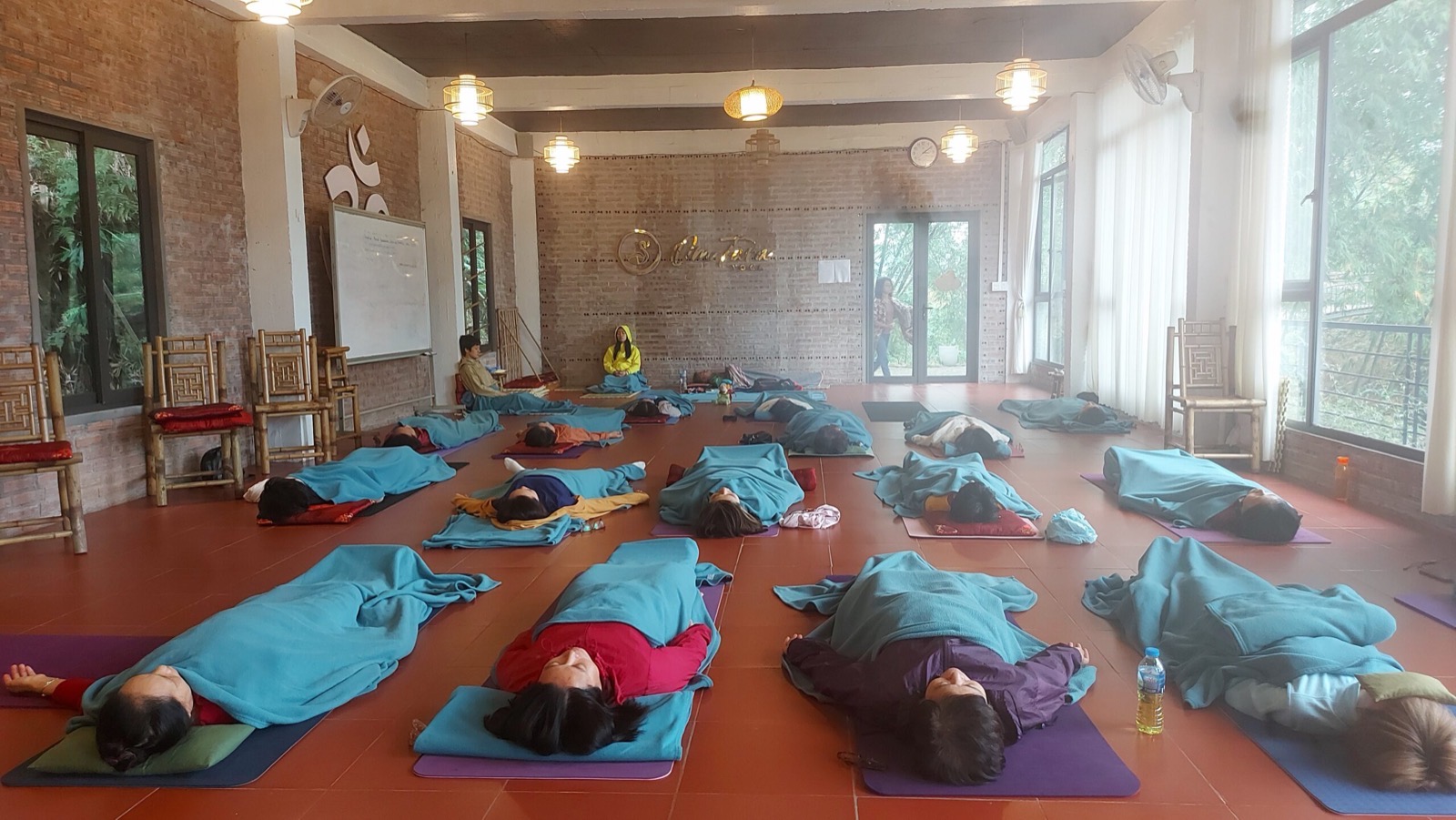
Yoga Nidra allows a deep state of relaxation and raised consciousness. Practised over the week, it can change the way you see death and dying.
Itinerary
The most beautiful moments in our lives are usually those when we feel connected, with no ego involved. Letting go of the ego, though, is one of the most difficult tasks.
It may be easy enough to let go of material possessions. Letting go of unresolved conflicts is harder; letting go of the role, the “I”-identity, is among the biggest challenges we face.
The experience that happiness can be present even in the most difficult circumstances will offer a new perspective for handling difficult situations.
Fearing a situation, a person, a decision or pain can put you under great stress, often without your knowing it. Triggers from past experience are pressed, and suddenly the body is tense: sweating, headaches, unrest.
Fear can be seen as a lack of connection with yourself – as not knowing who you really are. So we look outside, and identify with a job, a partner, a social status. But the outside changes, and with change comes fear.
The way to deal with fear is not to avoid it but to meet it from within. The key word is connection: a new way to connect with yourself, and a new way to connect with your fears.
Dream and sleep yoga has a long tradition in Tibetan Buddhism, and is one of the best preparations for conscious dying. We spend about a third of our lives asleep, most of it in deep unawareness.
By staying conscious during dreams, and during the phases of dreamless sleep, the illusions and fears of the dying process can be seen for what they are: projections of the mind. Every night becomes a chance to rest in the clear light, and to prepare to meet it during the process of dying.
How often do we wish to rest in peace, and cannot? The mind keeps spinning, jumping from one thought to another.
Deep peace becomes possible when we find connection within, and when we understand impermanence and death. Death is neither an ending nor a failure; it is a natural and important part of life.
With a true understanding of your own mortality, fear dissolves. The same holds in reverse: connect within, look within, experience impermanence, and the fear of death loses its hold. That inner refuge helps maintain peace during dying, and in the letting go of the outer world.
The best preparation for supporting others through dying is to prepare for your own death. Face your own fears first – your attachments, your ignorance, your egoism.
Once you can stay connected with your inner stillness, silence and spaciousness, it becomes possible to perceive the other person’s needs, because your own self is out of the way. Most carers were never taught this, and many dying people’s needs go unseen and unmet.
Fully present with a dying person, the ego steps back and there is simply this moment of being. It can become a moment of deep love, because you know there is nothing to fear.
A day here
In the ashram we maintain silence from 9:00 pm to the next morning 9:00 am to help us be more aware of our inner consciousness. Please cooperate.
Through the week
Fees cover
Your teachers
Sandra is a yoga teacher (RYT 500, Yoga Alliance USA) and a certified Yoga Nidra teacher (Yoga Alliance Professionals, UK). She has practised yoga and meditation since 1989.
She holds an MA in Sociology (University of Marburg, Germany), trained in arts therapy as a drama therapist (DGfT, Germany), and is a Conscious Aging Facilitator with IONS (USA). After training with spcare (Australia) in “Understanding Death, Caring for the Dying”, she developed a conscious dying approach based on the original teachings of Patanjali – one that turns the focus from “the other” back to oneself.
Before returning to Germany in 2017, she lived in Australia for 12 years.
Swami Yogaratna Saraswati was trained as a sannyasin disciple of the Bihar School of Yoga (BSY), which was founded by Swami Satyananda Saraswati, direct disciple of Swami Sivananda of Rishikesh.
With over 40 years’ experience in yoga and meditation, Swami Yogaratna has given yoga programs all over South India and overseas.
She is particularly appreciated for her talent in leading Yoga Nidra (psychic sleep) and other Meditations from the Tantras, Yoga Therapy, Yoga for children, the higher techniques of Chakra Sadhana, Kundalini Yoga and many others including Satsangs (talks) and Kirtan (group singing).
Things to do (optional)
Location, stay & food
The ashram is in the village of Bankikodla, Karnataka. Gokarna, an ancient temple town, is 5 km away: temples, beaches and a weekly market.
Twin shared room with attached bathroom. Rooms are in heritage buildings surrounded by gardens and the ashram’s organic farm, with twin beds and an attached bathroom with toilet and shower. Bed sheets and pillows are provided.
Dormitory with shared bathroom. The dormitories are in the century-old heritage house. They sleep between 2 and 5 people on sleeping pads. Clean toilets and bathrooms are shared. Bed sheets and pillows are provided.
Three vegetarian meals are served daily, with tea or coffee. Meals are cooked here — traditional, local vegetarian food. Shankar Prasad grows its own rice and many of its vegetables on the fully organic farm; what is not grown on the land is bought from organic farmers in the village and neighbouring town.
Dabolim (Goa) is about 3 hours by taxi, Manohar (Mopa, Goa) about 5. We can arrange a trusted village taxi: send us your flight details and it will be waiting.
Any train on the Konkan line. Gokarna Road is 20 minutes away by auto-rickshaw; from Kumta or Ankola take a bus or taxi. Overnight buses also run often from Mumbai and Bengaluru to Gokarna Cross. Full routes on the How to reach page.
Fees
Please inquire. We will share the current fee and how to hold your place.
Booking
Tell us your dates and we’ll confirm the next retreat, fees and how to hold your place.